

A timed practice exam is a full-length or section-length mock test that you take under the same clock the real certification exam will use, so you learn to recall what you know at test-day speed. It sounds simple, but it’s one of the most useful things a trades learner can do before sitting for a technical certification. Knowing the code book, the safety rules, or the theory is only half the job. You also have to find answers, read tricky wording, and finish every question before time runs out.
That’s where many capable apprentices and career-changers get caught. They understand the material in the shop or on the job site, then freeze or rush when a countdown timer is running. Timed practice fixes this by turning exam pressure into something familiar. You spot your slow sections, learn to pace yourself, and walk in calm instead of guessing.
In this guide, we’ll keep it plain and practical. You’ll see how timed practice exams work, the common formats you’ll run into, and a simple step-by-step routine you can start this week, even if you’ve never taken one before.
What Timed Practice Exams Mean for Trades Learners
A timed practice exam is a mock test you take under the same clock limits as the real thing. You sit down, start a timer, answer a set number of questions, and don’t stop until time runs out. It’s built to feel like test day, just without the pressure of your career riding on the result.
This applies to almost any technical credential you can think of: electrical licenses, HVAC certifications, plumbing exams, welding qualifications, automotive technician tests, and plenty of similar trades credentials. If a certification has a time limit and a set of multiple-choice style questions, a timed practice exam can help you get ready for it. Sites like powerengineeringpractice.com show how this works for technical fields, offering practice built around real exam conditions rather than casual review.
So how is this different from flipping through flashcards or taking a quick quiz on your phone? Casual quizzes let you pause, look things up, and take as long as you like. A timed practice exam doesn’t. The clock, the number of questions, and the no-peeking rules all mirror what you’ll face in the testing room. That’s what makes it such a good rehearsal.
A few simple terms will help you follow along:
- Timed practice exam
- A mock test taken under a strict time limit, designed to match the conditions of the real exam.
- Certification exam
- The official test that proves you’ve met the standards for a trade or technical credential.
- Time limit
- The total number of minutes or hours you’re given to finish all the questions.
- Question bank
- A large pool of practice questions that a test or study tool draws from, so each attempt can feel a little different.
- Pacing
- How you spread your time across the questions so you finish without rushing or running out of minutes.
- Passing score
- The minimum result you need to earn the certification.
Keep these in mind, because we’ll lean on them as we go. Once the vocabulary feels familiar, the rest of the process gets much easier to follow.
How Timed Practice Exams Work and Why They Build Test-Day Skills
Learning to Pace Yourself Before the Real Clock Starts
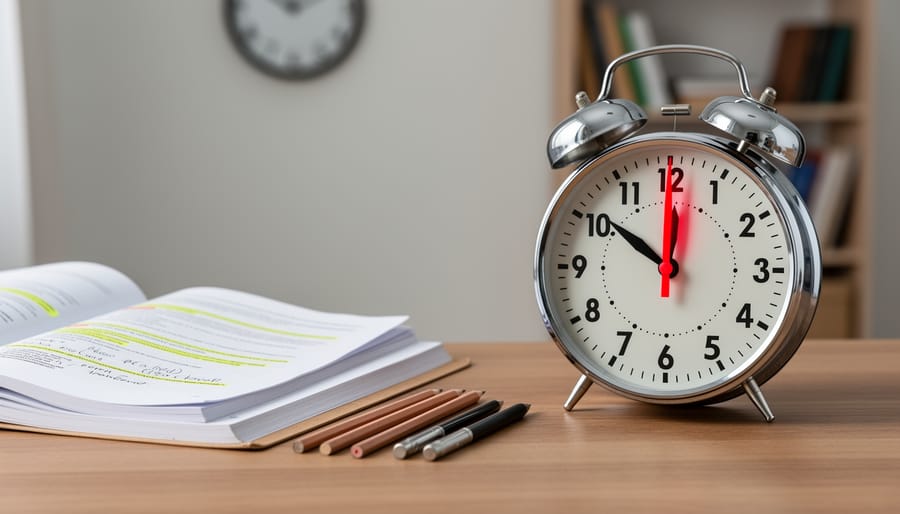
When the clock is running, it’s easy to get stuck. One tricky wiring-load calculation or a confusing diagram can swallow ten minutes, and suddenly the easy questions at the end are getting a rushed glance instead of a fair shot. Timed practice teaches you to notice that trap before it happens on test day.
Start by working out a rough pace. Divide the total minutes by the number of questions, and you’ll know about how long each one deserves. During practice, glance at the clock every ten or fifteen questions to check whether you’re on track.
If a question stumps you, mark it, make your best guess, and move on. You can circle back if time allows. Doing this a few times in practice turns it into a habit, so you grab every easy point first and still finish with time to spare.
Turning Nerves Into Familiarity
Feeling jittery before a certification exam is completely normal. A big part of that nervousness comes from the unknown: What will the screen look like? How fast will the clock seem to move? What if my mind goes blank?
Timed practice exams chip away at those unknowns. Each time you sit down with the clock running, you get a little more used to the rhythm of reading a question, making a call, and moving on. After a few rounds, the format stops feeling strange and starts feeling like something you’ve done before.
You’ll probably still notice a flutter of nerves on test day, and that’s okay. The difference is that you’ll recognize the setup and know how you handle it. Think of it like a trade skill: the first time is awkward, and repetition makes it second nature.
Types of Timed Practice Exams You Can Choose From
Not every timed practice exam looks the same, and that’s good news. Different formats train different skills, so you can mix them as your test date gets closer.
Full-length mock exams are the closest thing to the real test. You get the full question count and the full time limit, with no pauses. They’re best for building stamina and checking your pacing across the whole exam. Save these for the later stretch of your study plan, once you’ve covered most of the material. Taking one too early can feel discouraging for no good reason.
Section or topic-based timed drills zoom in on one area, like load calculations, refrigeration cycles, or weld symbols. You set a shorter timer and work only on that subject. These are perfect when your results show a weak spot. Think of them as targeted workouts: quick to schedule, easy to repeat, and useful at any point in your prep.
Short timed quizzes usually run ten to twenty questions in a small window. They fit into a lunch break or the end of a shift. Their real strength is retrieval practice, which means pulling facts out of memory instead of rereading notes. Use them often, especially in the early weeks, to keep material fresh and build a daily habit.
Code-book or open-reference practice matters if your real exam allows reference materials. Many trades tests let you bring a code book, and finding the right page quickly is its own skill. In this format, you practice flipping through your book under the clock, using tabs and highlights the way you will on test day. Start it a few weeks before the exam, and only use references your testing rules actually allow.
A simple way to blend them: quizzes daily, drills weekly, and full-length mocks in the final weeks, with open-reference practice running alongside if it applies to you.
How to Use Timed Practice Exams: A Step-by-Step Routine

Setting Up a Realistic Practice Space
A little setup goes a long way. The closer your practice session feels to the real thing, the more useful the score will be. Pick a spot where you won’t be interrupted, whether that’s a kitchen table at home or a quiet corner of the shop, and treat the session like the real appointment.
Here’s a simple checklist to run through before you hit start:
- Choose a quiet space and let others know not to disturb you.
- Set a visible timer to the exact time limit of your real exam.
- Keep only approved tools nearby, like the calculator or code book your test allows.
- Put your phone in another room, or at least on silent and out of reach.
- Clear your desk of notes and extra study materials.
Once you’re set, don’t pause the clock for snacks or distractions. If something interrupts you, note it and keep going. The goal isn’t perfection, it’s getting comfortable working under real conditions.
Reviewing Your Results Without the Stress
A score report can feel like a grade on your worth, but it’s really just a map. It shows you where to spend your next study hour.
Start by looking at your score by topic, not just the overall number. Then go through every missed question and sort it into one of three buckets:
– Knowledge gap: You didn’t know the material. Put this topic on your study list.
– Careless error: You knew it but misread the question or picked the wrong option. Slow down and underline key words next time.
– Time pressure: You ran short and guessed. Practice pacing so you finish with minutes to spare.
Write the bucket next to each miss in a simple notebook. After a few exams, patterns jump out, and that’s exactly what you want to see.
One low score isn’t a verdict. It’s feedback, and you can act on it right away.
Real Learner Stories: What Timed Practice Looks Like in Action
Many trades learners describe a similar arc when they add timed practice to their prep. At first, the clock feels loud. Questions that seemed easy at the kitchen table suddenly take twice as long, and the final section gets rushed. After a few mock exams, though, the pattern changes. Learners often say they stop panicking over one tough question, make a quick mark to return later, and finish with minutes to spare.
Others notice that their review habits matter as much as the practice itself. Sorting misses into “didn’t know it,” “misread it,” and “ran out of time” gives them a clear next step instead of a vague worry.
[EDITOR NOTE: Only add genuine, verified learner testimonials here, with permission. Do not invent or paraphrase quotes. If none are available, keep the general descriptions above.]
If you’re building a study page or practice portal on WordPress to share resources like these, a few tweaks for faster image loading can keep your diagrams and charts snappy for everyone.
Common Questions About Timed Practice Exams
Starting out, it’s normal to have a few questions about how to fit timed practice into your study plan. Here are answers to the ones learners ask most often.
When should I start timed practice?
Try one timed test early as a baseline, even if you feel unprepared. Then spend most of your early weeks studying topics untimed, and shift to regular timed practice as the exam gets closer.
How many practice exams should I take?
There’s no magic number. Take as many as it takes to feel steady on pacing and to stop missing the same kinds of questions, and always spend time reviewing each one.
What if I run out of time?
That’s useful information, not failure. Practice skipping tough questions, flagging them, and coming back once you’ve collected the easier points.
Is a low practice score a bad sign?
Not at all. A low score just shows you where to focus, and it’s much better to learn that during practice than on test day.
Do practice exams match the real test exactly?
Usually not word for word. Good practice exams copy the style, topics, and time pressure, so use them to build skills, and check your certifying body’s official outline to confirm what’s covered.
If you’re ever unsure, go back to the basics: practice under the clock, review what you missed, and repeat. Small, steady sessions add up faster than you’d expect, so be patient with yourself as the process starts to click.
Timed practice exams take a big, intimidating certification test and make it familiar. The idea is simple: define your target exam, practice under the clock, review every miss, and repeat. Each round builds pacing, calm, and confidence a little at a time.
If you’re building a study site or blog to share what you learn, the same patient approach works there too. A few small habits, like learning how to optimize for SEO and setting up a plugin such as All in One SEO add up quickly. And if you ever refresh your pages, you can avoid losing traffic by planning ahead.
For now, start small. Pick one baseline timed test this week, set the timer, and see where you stand. You’ve got this, and every practice round gets you closer to passing.